Decision guide
Private Label Haircare MOQ: Find the Binding Minimum
- Published
- August 7, 2026
- Last verified
- August 7, 2026
TL;DR
Find the binding MOQ by converting every formula, filling, component, decoration, and carton minimum into a finished-unit equivalent. Then compare what will be filled, what must be purchased, what may remain, the total cash committed, and what the route means for a later run. Repeat the calculation for every proposed product.
Private label haircare MOQ is not one supplier number. It is a stack of minimums attached to the formula batch, filling run, bottle or jar, closure, decoration, label, carton, and other project inputs. The useful question is not “What number did one supplier quote?” It is “Which input becomes binding for this SKU, and what inventory and cash does that decision leave behind?”
Next step
Plan a private label haircare line
See how this decision fits into channel-led product-line planning, launch coordination, and reorder readiness.
Private label haircare MOQ is a stack of minimums
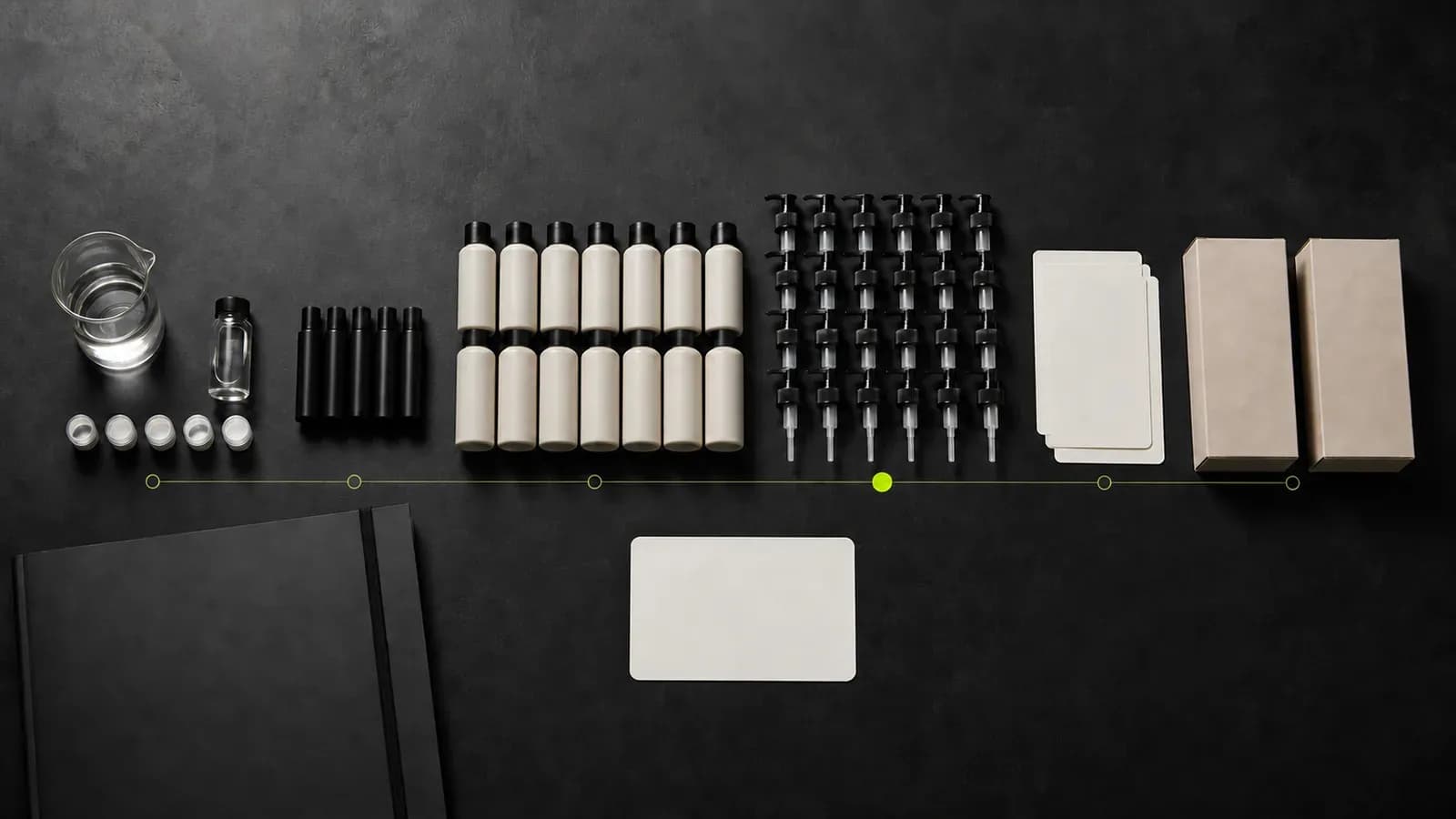
Review MOQ as a waterfall. Each layer can carry a different order multiple, setup condition, lead time, usable yield, or unused balance. One layer may set the finished run while another creates the largest purchase or leftover. Reconcile the layers for each proposed product before adding the quantities together at line level.
| Waterfall layer | What can set the minimum | What to confirm |
|---|---|---|
| 1. Formula batch | The batch size and production conditions attached to the selected stock, modified, or custom formula path. | Batch size, fill-size conversion, agreed process allowances, formula availability, and whether the batch can be divided or retained. |
| 2. Filling run | Line setup, fill size, run efficiency, product format, and the quantity accepted by the filling partner. | Minimum run, setup conditions, production assumptions, run scheduling, and the quantity expected after filling. |
| 3. Primary packaging | Bottle, jar, tube, closure, pump, sprayer, or other component pack quantities. | Stock availability, component-manufacturing minimum, case pack, lead time, color, material, and compatibility review. |
| 4. Decoration and labels | Printing, coating, labeling, tooling, plates, setup, or decoration-partner requirements. | Setup cost, minimum decorated quantity, artwork readiness, process allowance, and color or finish limits. |
| 5. Secondary packaging | Cartons, inserts, seals, bundles, and outer-case pack quantities. | Minimum, pack-out, material specification, artwork, and whether the item is required at launch. |
| 6. Total project economics | The combined purchase, setup, freight, handling, testing, documentation, storage, and multi-SKU commitment. | Total cash committed, sellable units, leftover inputs, landed-cost assumptions, sell-through plan, and reorder timing. |
The binding layer varies by formula, component, decoration, partner, and production run. This table does not establish a universal minimum.
Reconcile the waterfall in finished units
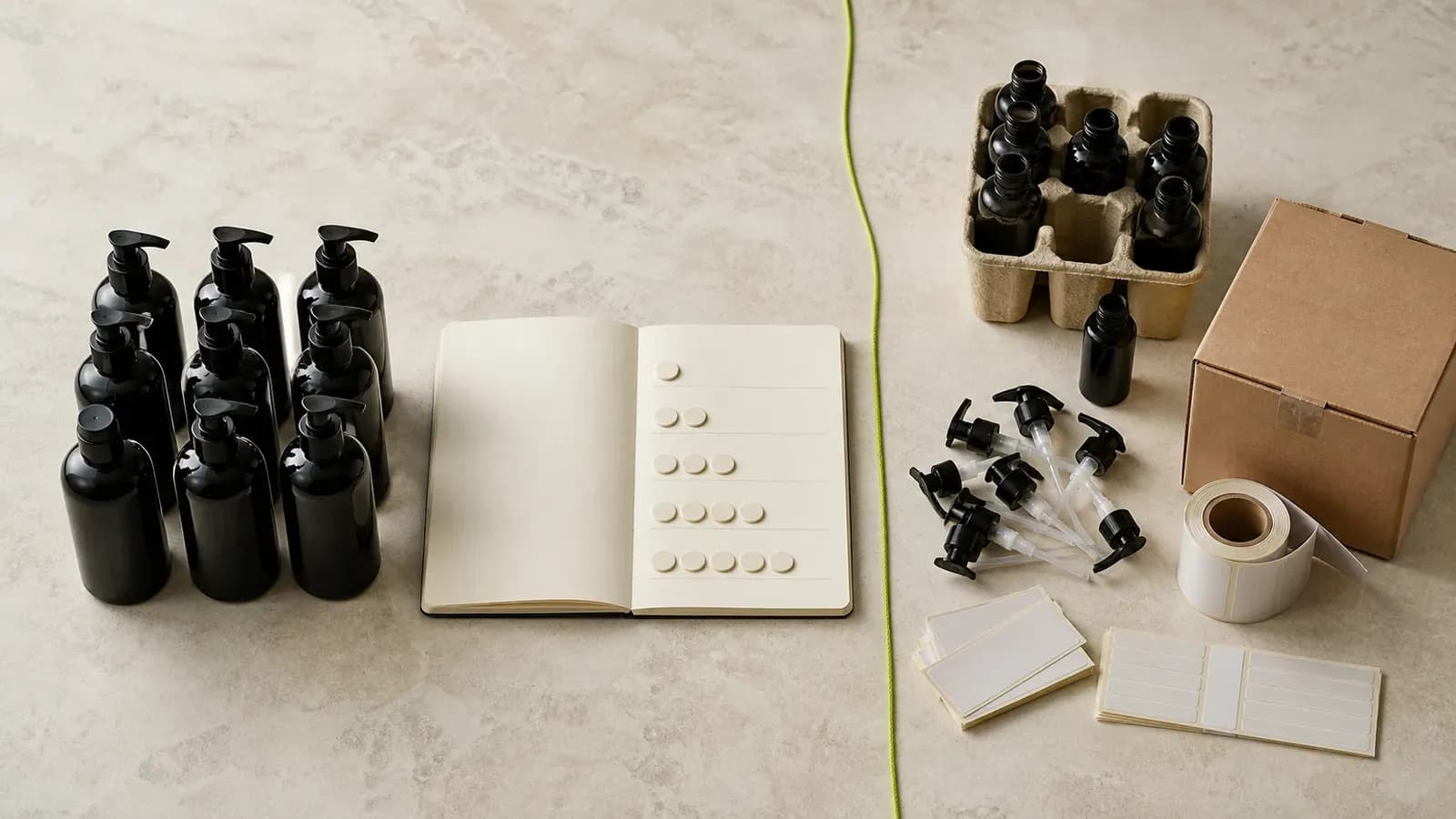
Convert every input into the same working unit: the number of finished units it can support at the proposed fill size. Then show the purchase quantity beside it. The gap between what is purchased and what is filled is part of the decision, even when the material could be used later.
| Input | Illustrative quantity | Decision effect |
|---|---|---|
| Channel demand plan | 1,500 finished units | The commercial target used to compare the supply inputs. |
| Formula batch | Equivalent to 1,800 fills in this example | Supports a larger run than the demand plan after applying the example assumptions. |
| Filling run | 1,500-unit minimum | Does not become the largest constraint in this example. |
| Bottles and labels | 2,000 of each | A run of 1,800 would leave 200 bottles and 200 labels before other agreed allowances. |
| Pumps | 2,500 | Creates the largest component purchase and leaves 700 pumps after the illustrative 1,800-unit run. |
Illustrative arithmetic only—not a FormuLaunch qualification range, partner quote, production assumption, or available offer. Actual quantities require project-specific review.
Price the exposure, not only the filled unit
A route can look attractive on finished-unit cost while asking the business to buy more components than it can turn into sellable inventory today. Compare the complete commitment: finished goods, unused formula or components, setup charges, freight, storage, handling, testing, documentation, and the conditions for using a balance later. Treat a leftover as an asset only after ownership, condition, location, identification, and future compatibility are confirmed.
Five figures for comparing MOQ routes
Put these figures on the same page for each SKU and for the proposed line as a whole.
- 01
Finished goods and demand window
The finished quantity the channel plans to receive and the period in which it expects to sell through it.
- 02
Purchased inputs and fill equivalent
The quantity purchased at each waterfall layer and the finished-unit equivalent of that purchase.
- 03
Leftover inventory
Every formula, component, label, or carton balance expected after the planned run, including its owner and location.
- 04
Total cash committed
Product, packaging, setup, freight, handling, storage, test, documentation, and other confirmed project costs.
- 05
Reorder consequence
The inputs that must be repurchased or reconfirmed for the next run and the earliest useful review point.
Which choices can move the binding layer?
Changing the route can move a constraint rather than remove it. A stock bottle may reduce a component minimum while the pump case pack or formula batch still controls the project. A simpler label may remove a decoration setup while a carton becomes the next large purchase. Recalculate the full waterfall after each material change instead of carrying forward the old finished-unit number.
MOQ decision levers
Test these choices one at a time so the effect of each change remains visible.
- 01
Formula path
Compare the available formula paths at the intended fill size and with the required project support.
- 02
Primary component path
Compare stock and made-to-order bottles, jars, tubes, closures, pumps, or sprayers that still fit the product job.
- 03
Decoration and label path
Separate essential brand and market requirements from finishes or processes that can change if they become binding.
- 04
Secondary-packaging scope
Review whether a carton, insert, seal, bundle, or other secondary item belongs in the first run.
- 05
Number of products
Recalculate every proposed product separately, then review the combined cash and inventory exposure.
Private label haircare MOQ FAQ
FAQ
Questions before you start
Is a component MOQ the finished-product MOQ?
The formula, filling run, bottle, closure, decoration, label, carton, or partner requirement can each create a different minimum. Reconcile all layers in finished-unit equivalents, then review the purchases and balances attached to the proposed run.
Can simpler packaging reduce MOQ?
It can remove one constraint. The formula batch, filling run, closure case pack, label, carton, or total project commitment may still control the route. Recalculate the waterfall with the selected stock component before comparing finished units and cash exposure.
How does product count affect total MOQ?
Each added product can bring its own formula batch, filling setup, components, decoration, artwork, sampling, and inventory. Review the waterfall by SKU first, then combine the cash and inventory commitments before fixing the launch scope.
Can leftover components be used for a reorder?
A remaining input may support a later run when its ownership, storage location, condition, identification, availability, and compatibility with the future formula, component set, artwork, and production plan are confirmed. Record those conditions instead of assuming the balance will be usable.
How is MOQ confirmed for a FormuLaunch project?
FormuLaunch reviews the proposed product role, formula path, fill size, components, decoration, secondary packaging, target market, quantity, and reorder context with the relevant partners. The project record identifies the current assumptions, binding layer, open questions, and quantities that still require confirmation.
Next step
Check Your Project Fit
Share each proposed product role, quantity, fill size, packaging direction, target market, and reorder expectation so the likely MOQ waterfall can be reviewed in context.